



The Best Villages in the Dordogne for UK Expats
Few corners of France have drawn British buyers as steadily as the Dordogne. Honey-coloured stone, river valleys, weekly markets and a cost of living that still feels gentle next to much of southern England have made it a first choice for retirees, remote workers and families for more than thirty years. The harder question is not whether to move to the Dordogne, but where. The département is bigger than most people expect, and a village that is perfect for a summer fortnight can feel very different on a wet Tuesday in February.
This guide picks out the villages British newcomers most often settle in, what each one is actually like to live in, and who it suits. Because we move households from the UK to rural France every season, we have also added the part most village guides leave out: what moving day looks like when your new front door is on a medieval lane. If you are already at the planning stage, our removals to the Dordogne page covers the service itself.
Here’s what we cover:
- The four Périgords: choosing your corner
- The best villages for UK expats
- Beautiful to visit, harder to live in
- Just over the border: the Lot and the upper Dordogne
- Six things to check before you choose
- Moving day in a Dordogne village
- Dordogne villages FAQs
A quick note before we start: we are removals specialists, not estate agents or immigration advisers. Market days, flight routes and residency rules change, so treat this as a practical starting point and check the current position locally before you commit.
The Four Périgords: Choosing Your Corner
Locals still divide the Dordogne into four Périgords, each named after a colour. The names are a useful shorthand, because the landscape, the pace and the property market genuinely shift as you move across the département.
Périgord Vert (green, the north)
Rolling pasture, chestnut woods and more rain than the south. Quieter, greener and often better value, with Brantôme and Nontron as the anchors.
Suits: space, gardens, a lower budgetPérigord Blanc (white, the centre)
Named after its pale limestone. Home to Périgueux, the département’s capital, plus the Isle and Dronne valleys and Ribérac to the west.
Suits: being near services and the main hospitalPérigord Pourpre (purple, the south west)
Wine country around Bergerac and Monbazillac, with bastide villages such as Eymet and Issigeac. The most established British community.
Suits: first-time movers, an English-speaking networkPérigord Noir (black, the south east)
Dense oak woods, castles, cliffs and the Dordogne and Vézère valleys around Sarlat. The most spectacular and the busiest in summer.
Suits: postcard views, holiday letsThe Best Villages in the Dordogne for UK Expats
These are the places we are asked about most, roughly from the south west round to the north. Market days are the traditional ones and can shift with the season, so check with the local tourist office before you plan a viewing trip around them.
1. Eymet: the most British village in the Dordogne
A 13th-century bastide in the Périgord Pourpre, around half an hour south of Bergerac, Eymet is the village most associated with British expats in all of France. The arcaded square fills for the Thursday market, English is heard as often as French at the café tables, and there are clubs and societies run by and for newcomers.
Who it suits: anyone moving alone, retiring, or nervous about their French, who wants a ready-made social circle from the first week. The honest catch: some people find it too British, and end up moving a few kilometres out into a hamlet where they have to speak French at the boulangerie.
2. Issigeac: medieval lanes and a famous Sunday market
South east of Bergerac, Issigeac is a tight knot of timber-framed houses wrapped around its church and bishop’s palace. Its Sunday morning market is one of the best known in the region and draws visitors from miles around.
Who it suits: people who want real medieval character with Bergerac’s shops, vineyards and airport close by. Moving day note: the lanes inside the village are far too narrow for a removal lorry, so homes in the centre are delivered by a smaller vehicle shuttling from the edge of the village.
3. Monpazier: the bastide an English king built
Monpazier was founded in 1284 by Edward I of England, and its near-perfect grid of streets, covered market hall and arcaded square are among the best preserved in France. It is listed as one of the Plus Beaux Villages de France, with a Thursday market.
Who it suits: buyers who want beauty and calm, and do not mind being further from a big supermarket and a hospital. It feels more remote than it looks on a map, roughly 45 minutes from Bergerac and a little less from Sarlat.
4. Belvès: the village of seven bell towers
Perched on a ridge above the Nauze valley, Belvès is another of the Plus Beaux Villages, with a Saturday market and views across the forest of the Périgord Noir. Unusually for a hilltop village, it has its own railway station in the valley below.
Who it suits: those who want the Périgord Noir without the peak summer crowds of Sarlat, and like the idea of a train as well as a car.
5. Saint-Cyprien: the practical choice
Saint-Cyprien is less famous than its neighbours and that is exactly its appeal. About 20 minutes west of Sarlat, it has a lively Sunday market, supermarkets, doctors, pharmacies and schools, and it stays alive through the winter.
Who it suits: families and year-round residents who want the Périgord Noir scenery on the doorstep but need a place that works on a weekday in January.
6. Limeuil: where two rivers meet
Limeuil climbs the hillside above the meeting of the Dordogne and the Vézère, with canoes pulled up on the little beach below. It is small, steep and another Plus Beaux Villages member.
Who it suits: river lovers who are happy to drive for most errands. Moving day note: the lanes are steep and tight, so tell us the exact address early and we will plan the access at survey stage.
7. Domme: a clifftop bastide with the best view in the valley
Founded in 1281, Domme sits on a cliff high above the Dordogne, and its belvedere looks out over one of the most photographed river views in France. The old town is walled, with a Thursday market.
Who it suits: buyers who want a view they will never tire of, and can live with coach parties from Easter to October. Car access inside the walls is limited, which matters on moving day.
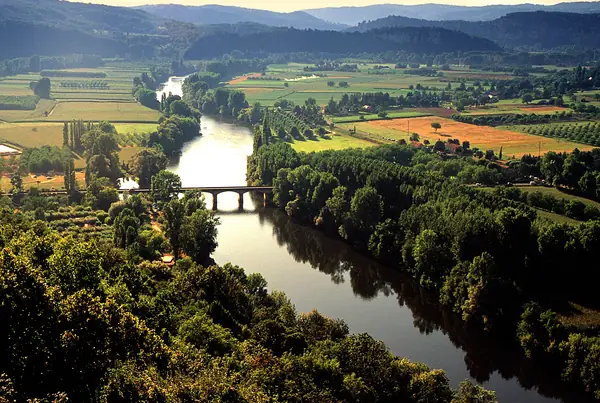
The view that sells the Périgord Noir: the river Dordogne winding through the valley below the clifftop bastide of Domme.
8. Brantôme: the Venice of the Périgord
Wrapped in a loop of the river Dronne, with its abbey built into the cliff behind, Brantôme is the jewel of the Périgord Vert. The Friday market is busy, the town has everyday shops and services, and Périgueux is around half an hour away.
Who it suits: people who want a greener, quieter north with good value in the surrounding countryside, while still having a proper small town to walk into.
9. Ribérac: market town life in the west
Strictly a small town rather than a village, Ribérac is the hub of the western Dordogne and home to one of the larger British communities in the area. Its Friday market is the social event of the week, and it sits handily for the Charente to the west.
Who it suits: people who want the villages of the Dronne valley around them, with a town that has everything within ten minutes.
Beautiful to Visit, Harder to Live In
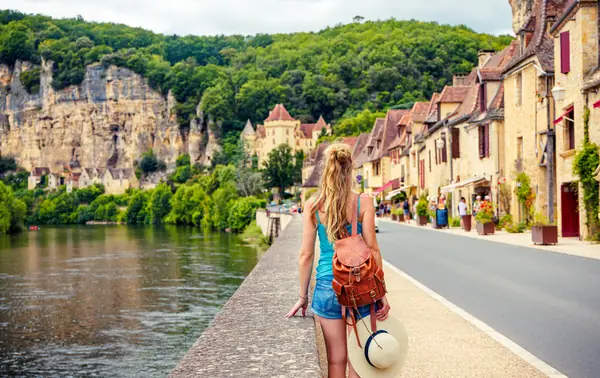
La Roque-Gageac, pictured at the top of this guide, is one of the loveliest villages in France: a single row of golden houses squeezed between a limestone cliff and the river, with the turrets of the Château de la Malartrie at one end. It is also a good example of why the most beautiful villages are not always the best places to live.
Very few homes come up for sale. There is one road through, and in summer it carries a steady stream of cars and coaches. The river has flooded the village before, and the cliff itself has needed work after rockfalls. None of that stops people living there happily, but it does mean the same questions apply to any riverside or cliffside village: how do you get in and out in August, what happens in a wet winter, and what did the notaire’s risk report say?
Beynac, Castelnaud and Sarlat’s old quarter fall into the same bracket. Wonderful to be near, and plenty of British owners live in the hamlets just outside them, where parking, gardens and winter life are easier.
Just Over the Border: the Lot and the Upper Dordogne
The Dordogne département and the river Dordogne are not the same thing, and many people house-hunting in “the Dordogne” end up looking a little further afield. To the south east lies the Lot, with its own dramatic villages, and the river itself rises far to the east in the mountains of the Massif Central.
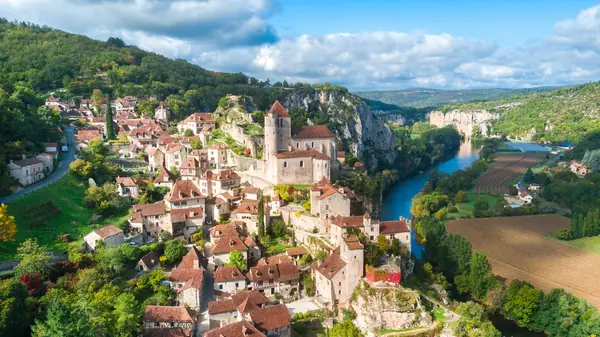
Saint-Cirq-Lapopie clings to a cliff above the river Lot. It sits in the neighbouring Lot département, an easy day out from the southern Dordogne.
Villages such as Saint-Cirq-Lapopie, perched above the Lot valley, attract the same kind of buyer and the same kind of move. Further upstream, the Dordogne river flows through the Corrèze and the Cantal, where lakes, gorges and castles such as the Château de Val give a very different, more mountainous flavour, with colder winters to match.
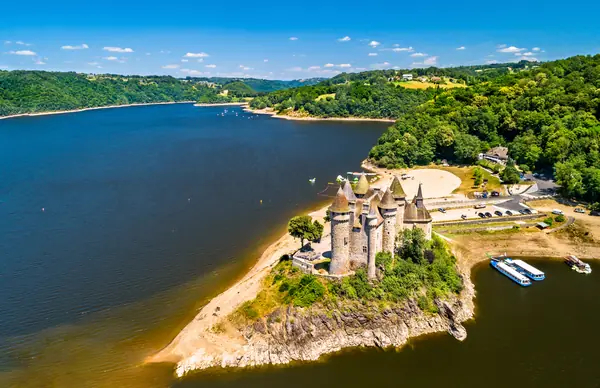
The Château de Val stands on the upper Dordogne river in the Cantal, far upstream of the département that shares the river’s name.
To the west, the Charente offers a quieter, flatter and often cheaper alternative that is popular with British buyers in its own right. We cover it on the same run, and you will find it alongside the Périgords on our Dordogne removals page.
Six Things to Check Before You Choose
- Visit out of season. Plenty of villages are buzzing in July and almost shuttered in January, when restaurants close and holiday homes sit empty. Spend at least a few days there between November and March before you buy.
- Measure the drive to a hospital. The main hospitals are in Périgueux, Bergerac and Sarlat. Twenty minutes to A&E feels short at 60 and a lot longer at 80.
- Check the risk report. Every French sale comes with a statement of natural risks for the property. Along the rivers, read the flood section carefully.
- Test the broadband and phone signal. Coverage has improved a lot, but it still varies from hamlet to hamlet. If you work from home, check the actual address, not the village.
- Be realistic about getting back to the UK. Bergerac airport is the closest, but UK routes there have come and gone in recent years, so check the current schedule. Bordeaux, around two hours away, has year-round flights. By road it is roughly nine to ten hours from Calais.
- Sort out residency first. Since Brexit, UK citizens need a long-stay visa to live in France for more than 90 days in any 180. Our guides to how long you can stay in France without becoming resident and retiring to France from the UK cover the detail.
Moving Day in a Dordogne Village
Village life is the reason people move here, and village streets are the reason the removal needs a little more thought than a move to a French city. Medieval lanes, arched gateways, weight limits on old bridges and steep gravel drives all shape how your belongings reach the door.
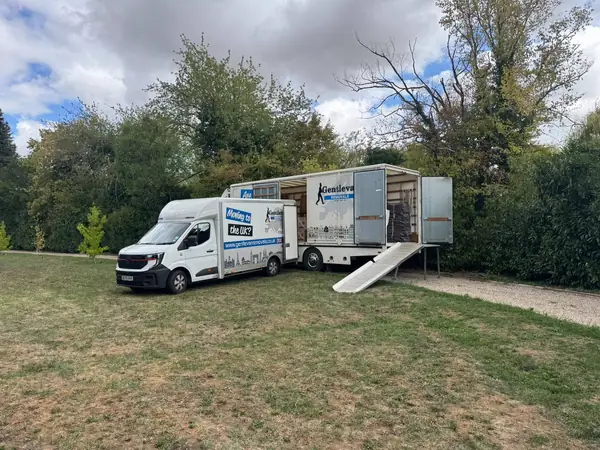
Our fleet runs from vans up to a 36-tonne road train. Where a lane is too narrow for the lorry, a smaller van shuttles your belongings the last stretch.
Getting a big load into a small lane. The main load travels on a large vehicle, which keeps the cost down over the long drive. Where the lorry cannot reach your door, we use a smaller van to transfer everything the final distance. We plan this from your video survey, so it is built into the quote rather than discovered on the day.
Parking and the mairie. In most villages the lorry or van will need somewhere to stand for several hours, and permission comes from the local town hall. At survey stage we check the access and tell you whether a parking authorisation is needed. Booking it is the customer’s responsibility, but we can apply for it on your behalf for a small extra fee if you would rather we did. Our guide to removal van parking permits explains how it works in France.
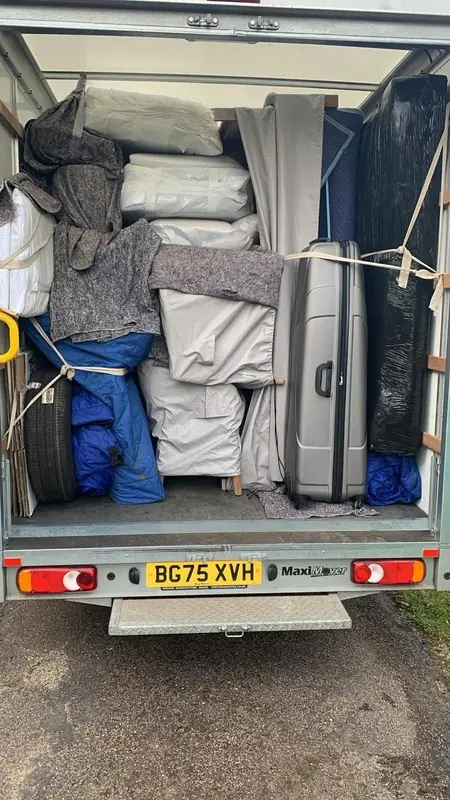
Blanket-wrapped furniture strapped in place for the journey. Packing and export wrapping are optional and chosen at quotation stage.
Packing, paperwork and the price. You choose how much packing we do: a full pack, fragile items only, or you pack and we load. Whatever you choose, we write a full inventory on every European job, because it forms the basis of the customs paperwork, which is handled through the experienced customs agent we use on French moves. If you are moving a smaller household, a shared load to France lets you pay only for the space you use and typically saves 40 to 50% against a dedicated vehicle. Shared-load moves to France start from £1,200.
Not found the right village yet? Many buyers rent first, or complete later than planned. We can hold your belongings in sealed, numbered containers at our storage facility in Oxfordshire until your French home is ready, then deliver when you are. Our own crews handle the move, and larger items such as pianos are planned in from the survey.
Whichever village wins your heart, you can get a starting figure from our online quote, send us a room-by-room video on WhatsApp on 07861 930529, or read more about our removals to France service.
Dordogne Villages FAQs
Which Dordogne village has the most British expats?
Eymet, a bastide village south of Bergerac, is the best known and is often described as the most British village in France. Ribérac and the villages of the Dronne valley in the west, and the area around Issigeac, also have large, long-established British communities.
Is the Dordogne a good place for British retirees?
For many people, yes. It offers a slower pace, good food, lower living costs than much of southern England and an established English-speaking community. The points to weigh are the distance to a hospital, how quiet some villages become in winter, and the post-Brexit residency rules, since UK citizens need a long-stay visa to live in France for more than 90 days in any 180.
What is the cheapest part of the Dordogne to buy in?
As a general rule the Périgord Vert in the north and the less touristy parts of the west offer better value than the Périgord Noir around Sarlat or the villages on the river itself. Prices vary a great deal by property, so compare like for like with a local agent.
How far is the Dordogne from the UK?
By road it is roughly nine to ten hours from Calais to the Bergerac and Sarlat area. Bergerac airport is the closest to the villages in this guide, but UK routes there have changed in recent years, so check the current schedule. Bordeaux, around two hours away, has year-round flights to the UK.
Can a removal lorry get into a medieval Dordogne village?
Often not right to the door. Where a lane, archway or bridge is too tight for the lorry, the load is transferred to a smaller van for the last stretch. A removal company should spot this at survey stage and build it into the quote.
Do I need a parking permit to move into a Dordogne village?
Usually, if the vehicle needs to stand on the street for the move. Authorisation comes from the local mairie. Booking it is normally the customer’s responsibility, although we can tell you at survey stage whether one is needed and apply for it on your behalf for a small extra fee.
Can you store my furniture while I look for a village?
Yes. We can keep your belongings in sealed, numbered containers at our storage facility in Oxfordshire until your French home is ready, then deliver them when you are.