MOVING TO MADRID FROM THE UK: THE 2026 LOGISTICS GUIDE FOR BRITS
MOVING TO MADRID FROM THE UK: THE 2026 LOGISTICS GUIDE FOR BRITS
Practical 2026 guide to moving from the UK to Madrid: ZBE Madrid 360 rules, empadronamiento, neighbourhood access for removal lorries, paperwork timing and how the move actually works.
Moving to Madrid from the UK in 2026: What the Generic Guides Don't Tell You
There are thousands of articles online about moving to Madrid. Most of them tell you the same things: Madrid has nice weather, the food is good, rent is cheaper than London. All true, all unhelpful when your actual problem is a removal lorry that can't fit down Calle del Pez, a 200€ low-emission-zone fine, or a town hall appointment six weeks away.
This guide is the one we wish our customers had read before booking us. It's the practical, logistics-focused, post-Brexit, post-ZBE-Madrid-360 reality of moving from the UK to Madrid in 2026, written by a UK removal company that runs the route regularly.
The Three Things That Catch Out British Movers in Madrid
Before we get into the city itself, three operational realities you need to plan around. None of them appear in the lifestyle guides, all of them cost real money or weeks of delay if you ignore them.
1. Madrid's Low Emission Zone (ZBE Madrid 360) Now Covers the Entire City
As of 1 January 2026, vehicles without a DGT environmental sticker (etiqueta ambiental) are banned from circulating anywhere in the municipality of Madrid, not just the centre. The fine is €200, reduced to €100 if paid within 20 days, enforced automatically by ANPR cameras. Inside the M-30 ring road and the two stricter zones (ZBEDEP Distrito Centro and ZBEDEP Plaza Elíptica), the restrictions are tighter still.
Three things this means for you in practice:
Your UK removal lorry needs to meet at least Euro 4 (diesel) emissions and have its emission category registered with the DGT before entering Madrid. We handle this for our own fleet on every Madrid run, but if you're using a cheaper company that doesn't, the fine ends up on your delivery cost.
If you're bringing your own UK car to Madrid, it needs to be checked against DGT environmental classifications before you arrive. Old diesels (pre-2014) are essentially undrivable in Madrid going forward, even for residents.
Distrito Centro (which includes the neighbourhoods Brits most want to live in, Malasaña, Lavapiés, Chueca, Sol, La Latina, Justicia) has stricter rules again: B-label and C-label vehicles can only enter if they park immediately in a private garage or authorised underground car park.
2. Delivery Vans Can Only Enter the Centre 10am-Noon, Weekdays
This is the single biggest piece of operational planning for a Madrid central move. Commercial vehicles delivering into Distrito Centro have a narrow legal window: typically 10:00 to 12:00 on working days, depending on the exact street and the carga y descarga (loading/unloading) signs. Outside that window, you cannot legally unload, or you risk a fine and being moved on.
What this means for your move: your delivery cannot just happen "whenever the lorry arrives". It has to be planned around that two-hour window, which in turn means our crew needs to be on site, with the van loaded and the keys to your new place ready, before 10am. We build this into every Madrid central job, but if you're organising a DIY move or hiring an unfamiliar firm, ask them directly how they plan to handle the centre access window.
3. Empadronamiento Is the Bottleneck, Not the NIE
Every guide tells you to get an NIE and a TIE. Fewer tell you that the empadronamiento, your registration at the Madrid town hall (Ayuntamiento), is what actually delays things, because almost everything else depends on it. Healthcare card, school enrolment, driving licence exchange, even some bank accounts: all require your volante or certificado de empadronamiento.
The process: book a cita previa at madrid.es/citaprevia (or call 010 from a Madrid number), select "Padrón, Altas, bajas y cambio de domicilio", choose the Oficina de Atención a la Ciudadanía (OAC) nearest to your new address. In central districts the wait can be 3-6 weeks for an appointment.
What you take with you:
Signed rental contract for the property (must be more than 6 months and signed within the last 5 years) or a signed authorisation from the property owner plus their ID copy
Original passport and DNI/NIE if you have one
Completed hoja padronal (registration form) for all adults moving in
The cita previa confirmation
At the end of the appointment, ask for a volante de empadronamiento printed on the spot, it's enough for 90% of subsequent procedures. The fancier certificado de empadronamiento (stamped, signed by the City Secretary) you only need for nationality applications or court matters. Both are valid for 3 months from the print date.
If you're still sorting out your NIE first, our step-by-step NIE guide for UK citizens walks through the cita previa, EX-15 form, €9.84 fee and everything else.
The Realistic Madrid Neighbourhood Guide for Brits (with Access Notes)
Every guide ranks neighbourhoods by "vibe". Here's the same list with the bit that actually matters for a removal: can the lorry get there, and what does that mean for your move-in day?
Chamberí: The Family Favourite
Wide tree-lined streets, mid-19th-century apartment buildings, good schools, central but not chaotic. From a removals point of view Chamberí is one of the easiest central neighbourhoods to deliver to, most streets accommodate a 7.5-tonne lorry with planning, and there are workable parking options for the cross-load. Expect to pay €1,800-2,800/month for a two-bedroom apartment in 2026.
Salamanca: The Upmarket Choice
Madrid's most expensive district, with grid-pattern streets that look easy on a map but are full of resident-permit-only parking and one-way restrictions. Most addresses still work for a full removal lorry with notice. Two-bedroom rents typically €2,400-3,500/month.
Retiro: Greenery and Calm
Borders the iconic Retiro Park and offers a slightly slower pace. Mostly accessible streets, though the closer you get to the park itself the tighter the parking. €1,700-2,500/month for two beds.
Las Tablas / Sanchinarro: Affordable Modern
30 minutes from the centre by metro but with the great advantage of being outside the M-30, which means easier vehicle access and much cheaper rents. New-build apartments, family-friendly, with proper underground parking, for a UK family arriving with an older diesel that's not Madrid-ZBE compliant, this is honestly worth considering. Two-bedroom rents around €1,300-1,800/month.
Malasaña: Trendy but Difficult
Bohemian, cool, walkable, full of cafés, full of narrow one-way streets that simply do not accommodate a removal lorry. This is the canonical "transhipment van" neighbourhood, we park outside the Distrito Centro perimeter and ferry your belongings in by smaller transhipment van during the 10am-12pm window. It works, but it adds time and requires a company that knows what it's doing. Two-bedroom rents €1,800-2,600/month.
La Latina: Historic, Charming, Logistically Brutal
Medieval street layout, Sunday flea markets, tapas everywhere, and lorry access ranging from "difficult" to "outright impossible" on some streets. Same transhipment-van approach as Malasaña. Cheaper than Salamanca: €1,500-2,200/month.
Chueca: LGBTQ+ Hub, Walkable, Same Access Issues
Lively, central, popular with younger expats, but inside the Distrito Centro ZBEDEP with the same vehicle restrictions as Malasaña. Plan accordingly. Rents €1,700-2,400/month.
The Madrid Move Timeline: What Actually Happens, in Order
Here's the practical sequence we walk our customers through:
3-4 months before: Apply for your Spanish visa (non-lucrative, digital nomad, work, or Golden Visa) at the Spanish Consulate in London, Edinburgh or Manchester. Get an NIE if you don't have one. Full NIE guide here.
6-8 weeks before: Book your removal. Confirm your Spanish address (sign the rental contract). Get your DGT environmental classification sorted for your car if shipping it. Book your initial flights.
4 weeks before: Start packing non-essentials. We'll do the rest with a professional packing service closer to the date.
2 weeks before: Customs paperwork, we prepare the Transfer of Residence (ToR) inventory and personal effects declarations. You sign and return.
Moving day in the UK: Crew arrives, loads, departs. Typical UK→Madrid transit on our service is 4-7 days door-to-door, with optional free UK storage if your Spanish completion date slips.
Within 14 days of arrival in Madrid: Book your empadronamiento cita previa. Apply for your TIE residency card. Register with the local health centre.
Within 3 months of arrival: Sort private health cover (mandatory if you're not yet on the Spanish system), exchange your UK driving licence (you have 6 months from arrival before it stops being valid).
The Customs Reality for UK→Madrid (Post-Brexit)
Spain treats UK movers as a non-EU import. This means your personal belongings need:
A detailed inventory in Spanish (valued, itemised, we prepare this)
Your NIE certificate or TIE card
A Certificate of Empadronamiento from your new Madrid address (this is the chicken-and-egg part, you usually can't get this before arriving, so customs accept the rental contract as proof of intended residence in the interim)
Proof you've lived in the UK at least 12 months and owned the items at least 6 months (a key Transfer of Residence requirement)
A Toma de Razón stamp from the Spanish consulate, increasingly some customs offices ask for this; we'll tell you if your move needs one
Done properly, your used household goods enter Spain duty-free under Transfer of Residence relief. Done badly, you pay 21% IVA plus duty on the value of your inventory. This is where the wrong removal company costs you thousands.
How a Madrid Delivery Actually Reaches Your Door
None of the access rules above mean your belongings arrive in pieces or a week late. They mean the last stage of the journey is planned rather than improvised.
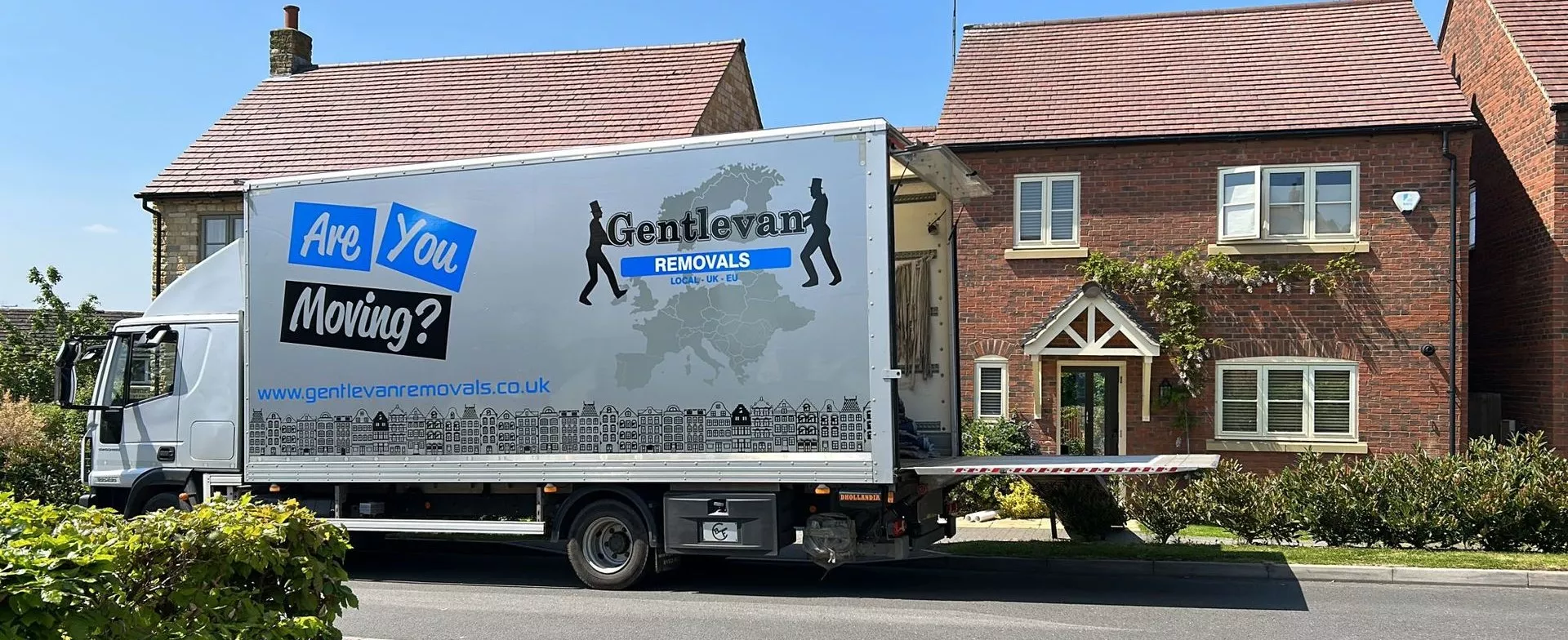
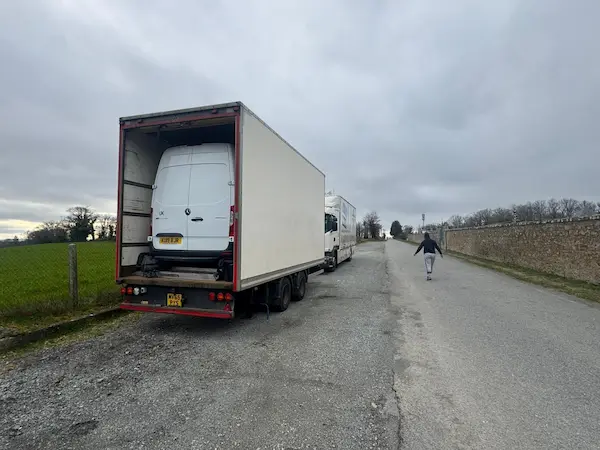
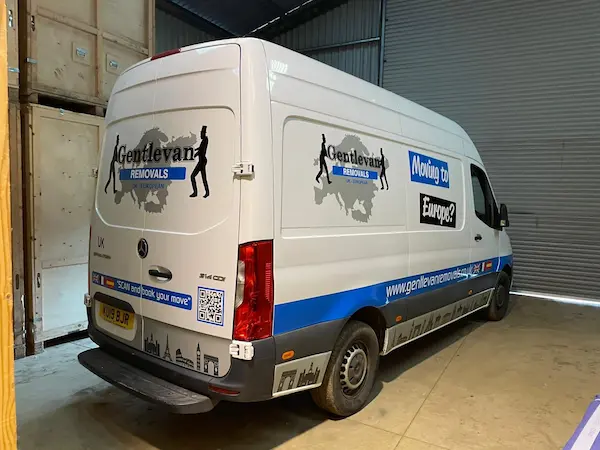
The lorry that leaves Oxfordshire carries a smaller van inside the trailer. On arrival we transfer your load into that van at a suitable spot outside the centre, then run it in to your address. The van fits the streets, sits under the weight band that governs daytime loading, and can use a loading bay where the lorry could not.
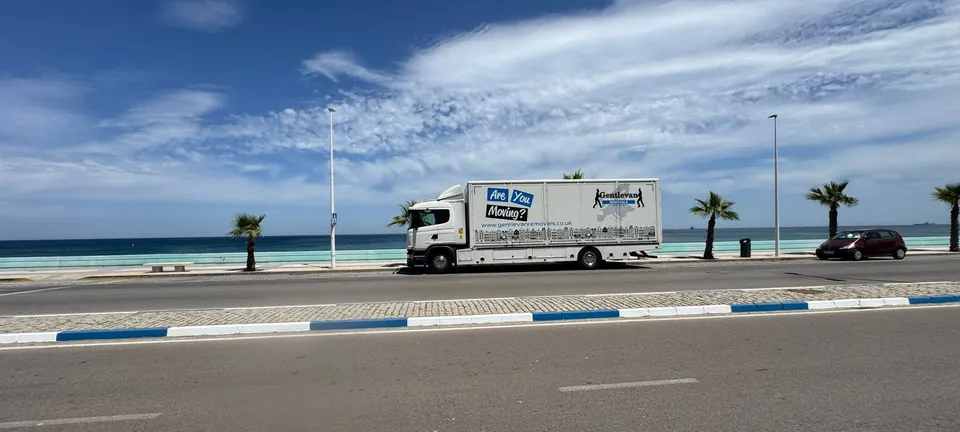
The van travels inside the trailer. This is how your belongings reach a door in central Madrid.Fully sign-written, so there is never any question about who is at the kerb.
It adds a step, and it is the reason a Madrid job is quoted differently from a Barcelona or Valencia one. It is also why a mover who only knows the motorway run struggles here.
Why a Specialist UK-to-Spain Mover Matters More for Madrid
Most UK removal companies will quote you for "removals to Madrid". Fewer can actually deliver to a fifth-floor walk-up on Calle del Pez within the 10am-12pm window, with a ZBE-compliant vehicle and the customs paperwork in order, without surprise charges.
At Gentlevan we run regular UK-to-Spain services and dedicated Madrid removals with a built-in solution for centre-city access: a smaller transhipment van travels inside our lorry's trailer on every Spain run. When the lorry can't reach the front door, we park on the outskirts, bring the transhipment van out, and shuttle your belongings into Distrito Centro within the legal window. Your move arrives at the door, one job, one team, no surprises.
We also offer:
Part-load options, share the run with other Madrid-bound customers and only pay for the space you use. See our part-load removals to Spain page.
Up to 2 months free UK storage if your Spanish completion date slips (and Madrid completion dates frequently do)
Customs paperwork prepared in-house, Transfer of Residence inventory, Toma de Razón guidance, the lot
Move Assured and AIM accredited, trained crews, full goods-in-transit cover, not random subcontractors
Ready to Make the Move?
Get a free online quote in under two minutes, book a free video survey for an accurate fixed price, or call us on 01295 368198 (office) or 07861 930529 (WhatsApp). We'll come back the same working day with a clear plan, price and timeline, including exactly how we handle your specific Madrid postcode.