



Removal Van Parking Permits: What You Actually Need
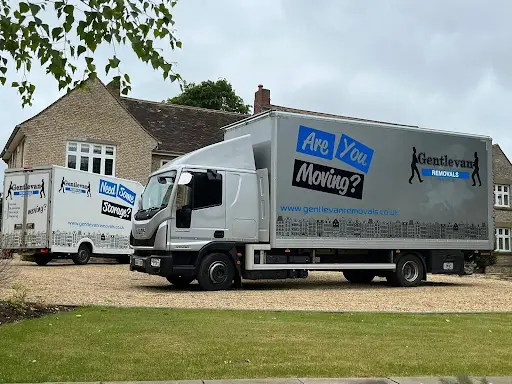
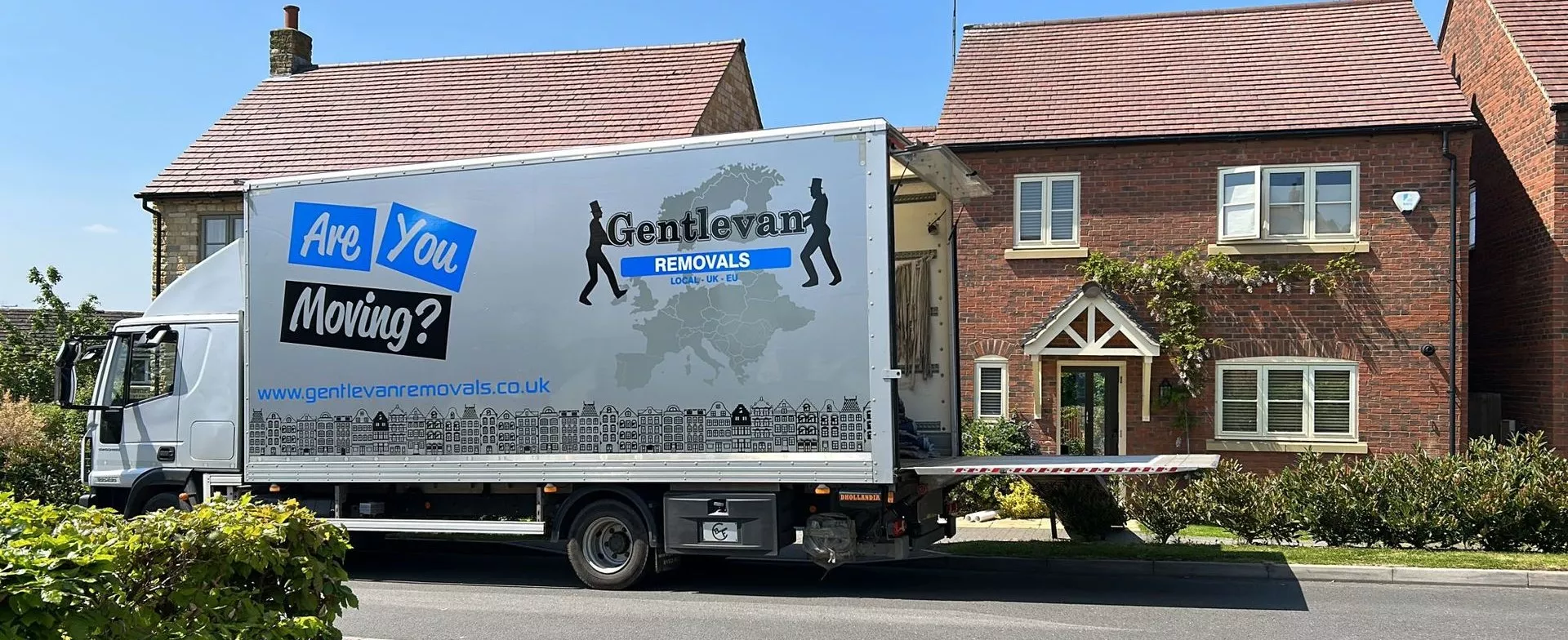
It is the detail almost nobody thinks about until the week of the move, and it is the one that most often turns a smooth moving day into an expensive one. Your removal van needs somewhere legal to stand, close to your door, for several hours. On most British streets, and in almost every European city, that is not something you can simply turn up and do. It needs paperwork, and the paperwork needs notice.
This guide explains what a removal van parking permit actually is, the difference between a suspension and a dispensation, how much it costs, how much notice your council needs, and what changes once you cross the Channel. We have loaded and unloaded on narrow streets from Banbury to Brussels, so as UK and European removals specialists we will also explain which parts of this we handle for you.
Here’s what we cover:
- Do you need a parking permit for a removal van?
- Suspension or dispensation: what’s the difference?
- Can a removal van park on double yellow lines?
- UK costs and notice periods
- London boroughs: what to expect
- European cities: Brussels, Paris, Madrid and Lisbon
- Other European cities at a glance
- What if a car is parked in your reserved space?
- What we handle for you
- Removal van parking FAQs
A quick note before we start: parking rules, fees and notice periods are set locally and they change, often every April in the UK and every January across much of Europe. Treat the figures below as a planning guide and confirm the current position with the relevant council before you apply.
Do You Need a Parking Permit for a Removal Van?
In most cases, yes. Unless you have off-street parking, a private drive or a gated development at both ends of the move, you will almost certainly need permission from the local authority to stand a removal vehicle on the street for the length of a house move.
The reason is simple. Loading and unloading is normally allowed for a short, continuous period only. In many London boroughs that limit is 40 minutes. A three bedroom house takes considerably longer than 40 minutes to load, so the moment your van is stationary beyond that window it is no longer loading in the eyes of the law, it is parked. Without a permit, that means a Penalty Charge Notice, and in the worst cases the vehicle being relocated or removed.
The exceptions are narrow. You will usually not need a permit if you have a private driveway the van can use, if your property sits in a gated development with vehicle access, or if the van is small, needs no tail lift, and there is a genuine loading bay directly outside.
Suspension or Dispensation: What’s the Difference?
These two words get used interchangeably and they are not the same thing. Getting the wrong one is one of the most common moving day mistakes.
A parking suspension
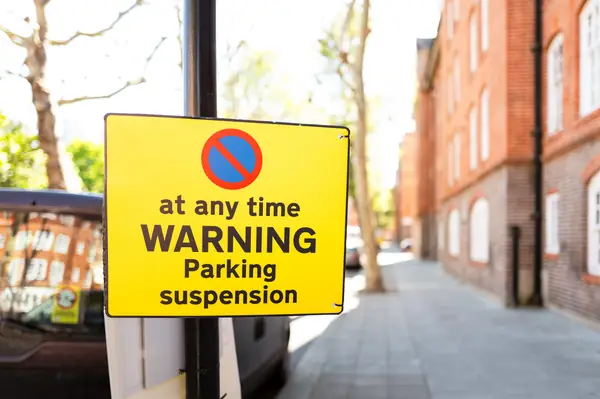
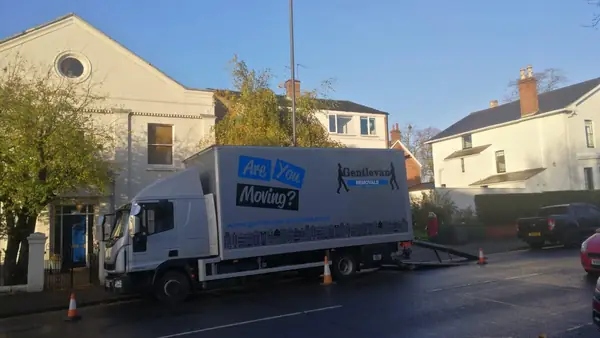
A suspension takes named parking bays out of use for a set period. The council places official yellow “parking suspended” signs on the street a few days beforehand, warning drivers to move. This is the one that actually clears space outside your door. For most residential moves in a controlled parking zone, this is what you want.
A parking dispensation
A dispensation is permission for a specific vehicle to stand somewhere it normally could not, typically a single yellow line, or in some cases a double yellow, without receiving a fine. What it does not do is reserve anything. If someone is already parked there when you arrive, that is your problem, not the council’s.
The short version: a suspension reserves the space, a dispensation excuses the vehicle. Busy residential street with permit bays? You want a suspension. Short window on a yellow line with no bays to suspend? A dispensation may be all that is available. Some moves need both, and if a vehicle is to stand in a suspended bay some councils will also want a dispensation for it.
Can a Removal Van Park on Double Yellow Lines?
Only for loading, only continuously, and only for a limited time. Double yellow lines prohibit waiting, but loading and unloading is generally permitted unless there are also kerb markings showing a loading restriction. The key word is continuously. If a warden watches your van sit still with nobody carrying anything for a few minutes, the loading defence starts to fall apart.
For a house move that runs for hours rather than minutes, the honest answer is that yellow lines are not a plan, they are a gamble. If your van needs to be there for the day, apply for a dispensation or a suspension. And be aware of the absolute no-go zones that no permit covers: bus stops, cycle lanes, dropped kerbs, zig-zags and, in London, TfL red routes, which are handled separately by Transport for London rather than the borough.
UK Costs and Notice Periods
There is no national system. Every council sets its own fees, its own notice period and its own application route, which is exactly why this catches people out. As a broad guide across the UK:
- Notice: commonly five to ten working days, though some London boroughs want considerably more and a few will take three. Weekends and bank holidays do not count as working days.
- Cost: typically an administration fee plus a charge per bay per day. Expect somewhere in the region of £50 to £300 for a standard residential move, and rather more in central London.
- Late applications: often possible, usually surcharged, and in some boroughs simply refused inside the window.
- Space needed: as a rule of thumb, a large removal vehicle needs roughly two standard bays, and two vehicles roughly three.
The single most useful thing you can do is apply the moment your completion or move date is confirmed. Nothing about this process rewards waiting.
London Boroughs: What to Expect
London is where this matters most, and where the variation is widest. A few real examples, current at the time of writing:
Two further points that catch people out. Red routes are TfL’s, not the borough’s, and need their own process. And if you are moving within London you need permissions at both ends, which may mean two different boroughs, two different forms and two different notice periods. Our removals to London page covers how we plan around this, and if you are moving locally our house removals service handles the same job across Oxfordshire and the surrounding counties.
European Cities: Brussels, Paris, Madrid and Lisbon
If you assume the UK approach travels, you will have a bad day. Every country does this differently, the notice periods are generally longer, and the applications are rarely in English. This is one of the quieter reasons people use an experienced European removals company rather than hiring a van.
Brussels: nineteen communes, nineteen processes
Brussels is the most misunderstood city on this list, because there is no such thing as a single Brussels parking permit. The Brussels-Capital Region is made up of nineteen separate communes, and each one runs its own temporary occupation of the public highway service, usually abbreviated to OTVP. Ixelles, Saint-Gilles, Uccle and Etterbeek each have their own form, their own office and their own tax rate.
The usual pattern is a two-step process. You first register the occupation on the regional platform, OSIRIS, which gives you a reference number, then you take that number to the commune to complete the request. Most communes want the application around seven working days ahead, and the parking prohibition signs are typically placed about 48 hours before the reservation starts. The charge is generally calculated by the area you occupy and the number of days, and the tax is indexed annually, so it moves.
Two practical warnings. Some communes will not clear a zone over a weekend, because the legal notice period for sign placement makes it impossible. And several central areas are pedestrianised behind automatic bollards, which needs a separate access request naming the person who will be on site and their mobile number. If Brussels is your destination, our removals to Belgium page explains how we plan around this.

Paris: the AOT, and fifteen days’ notice
Paris requires an Autorisation d’Occupation Temporaire, universally called an AOT. You need one if the vehicle will stand in the same place for more than six consecutive hours, if it needs to stand outside a paid parking strip such as a delivery zone or bus lane, or if you are using a furniture lift. Applications go through a Mon Paris account online, and the city asks for them at least 15 days before the move. Late requests are refused or simply not processed.
Three things surprise British movers. First, since March 2022 the AOT is chargeable, with the price depending on vehicle type, duration and whether a furniture lift is used. Second, the AOT is an authorisation, not a reservation: the city does not clear a space for you, it permits you to occupy a free one nearby. Third, moving day parking is restricted to between 7am and 8pm for noise reasons, and if you are moving from one Paris address to another you need two separate AOTs, one for each end. Registering the vehicle number plate against the authorisation is compulsory, and without it the permission is not valid. See our removals to Paris page for how this fits into a UK to France move.
Madrid: twenty days, and a weight threshold that matters
Madrid works to the Ordenanza de Movilidad Sostenible, and the trigger is the vehicle rather than the street. Authorisation is required when the vehicle exceeds 3,500kg maximum authorised mass, when a furniture lift or tail lift is used, or when a lift trailer is attached. Since almost every full household removal from the UK arrives on a vehicle well over 3.5 tonnes, this applies to essentially every international move into Madrid.
The fee has two parts: a fixed administrative charge of 60.52 euros for issuing the document, plus a reservation charge of around 0.58 euros per linear metre per day, with higher rates on premium streets. Total cost for a typical residential move usually lands somewhere between 65 and 100 euros. The notice period is the sting: applications should be submitted 20 calendar days before the date, and the legal maximum for a decision is three months.
Note also that the permit does not include the signage. Cones, barriers and notices are the applicant’s responsibility and are normally placed at least 48 hours ahead. And central Madrid sits inside a low emission zone, so the vehicle must be registered in the city’s access system as well as holding the occupation permit. Our removals to Madrid page covers the route itself.
Lisbon: two organisations, one street
Lisbon splits the job in two, which is what trips people up. The licence to occupy the public highway comes from the Câmara Municipal de Lisboa, applied for through the Loja Lisboa Online portal. But if the space you are occupying is metered parking managed by EMEL, you must also contact EMEL before the occupation starts and pay compensation for the tariffed bays you are taking out of use. One without the other is not enough.
The historic districts add a third layer. Alfama, Bairro Alto and similar areas are Zonas de Acesso Automóvel Condicionado, restricted vehicle access zones, and getting a removal vehicle in means sending EMEL a copy of the council licence together with the vehicle registration in advance. Enforcement is worth understanding too: only the Polícia Municipal can act against a car blocking your reserved bay, EMEL has no legal power to do it. Our removals to Lisbon page goes into the access side in more detail, and the wider removals to Portugal page covers routes and pricing.
Other European Cities at a Glance
Spain and France both set these rules city by city, not nationally, so the position changes every time you cross a municipal boundary. Here is where the other cities we serve stand. Fees and notice periods are revised regularly, so confirm the current position before you apply.
Three patterns are worth pulling out of that table:
- Who places the signs is not a detail. Lyon and Nice put them out for you. Madrid, Barcelona and Toulouse do not, and an unsigned reservation is close to worthless because it gives the police nothing to act on. Toulouse goes further and requires you to photograph the signage and notify the municipal police once it is up.
- Free does not mean easy. Bordeaux and Toulouse charge little or nothing, yet both are stricter on access than cities that charge. Toulouse’s 9 metre limit inside the boulevards rules out a full-size removal vehicle in the centre entirely, which is exactly the situation our transhipment setup exists for.
- Notice periods vary by a factor of ten. Alicante may take days, Valencia wants 15 working days and 30 for a pedestrian street, Madrid 20 calendar days. If you are moving to Spain, the permit lead time can genuinely be the thing that sets your moving date.
The pattern across both countries is the same: the rules follow the town hall, not the border. For the route itself, see our removals to Spain and removals to France pages.
What If a Car Is Parked in Your Reserved Space?
This is the question every experienced mover braces for, and the answer is uncomfortable: a suspension is a legal instruction, not a physical barrier. Councils place the signs. They do not guarantee the bays will be clear, and most explicitly say so in their terms. If a driver ignores the signs, the council may issue a penalty and may relocate the vehicle, but removal is rarely part of the suspension service and almost never happens quickly.
What actually helps is preparation. Check the signs are physically on the street, in the right place, at least 48 hours before the move, because errors do happen and there is still time to correct them. Tell your neighbours the date. Photograph the signs. If a vehicle is blocking on the day, report it immediately rather than an hour in. And if the signs have been removed or vandalised, tell the council straight away, since refunds are not usually given for a correctly signposted suspension that gets blocked anyway.

What We Handle for You
Access is not an afterthought for us, it is part of the survey. When we quote a move we look at the street as carefully as we look at the contents: where the vehicle can stand, how far the carry is, whether there is a lift, whether the road is wide enough for a large vehicle at all, and what permission the local authority needs. On European moves we also plan transhipment where the destination street simply will not take a full-size vehicle, which is a routine part of city centre work in places like Brussels, Paris and the Lisbon historic quarters.
Family run since 2011 and with more than 14 years on these routes, Gentlevan Removals is a member of Move Assured and the Association of Independent Movers (AIM). Alongside professional packing, specialist items such as pianos, seamlessly integrated UK storage and customs support, sorting out where the vehicle actually stands is simply part of the job. When you are ready, get a free quote and we will talk through the access at both ends.
Removal Van Parking FAQs
Do you need a parking permit for a removal van?
In most cases yes. Unless you have a private driveway or gated vehicle access at both ends, you will normally need a parking suspension or dispensation from the local council. Loading is usually permitted for a short continuous period only, often 40 minutes in London, and a house move takes far longer than that.
Can a removal van park on double yellow lines?
For continuous loading and unloading only, and only where there are no kerb markings showing a loading restriction. It is not a solution for a full day’s work. If the van needs to stand for hours, apply for a dispensation or a suspension instead. Bus stops, cycle lanes, dropped kerbs and red routes remain off limits.
What is the difference between a parking suspension and a dispensation?
A suspension takes named bays out of use and the council signs them in advance, so it reserves the space. A dispensation lets a specific vehicle stand where it normally could not, such as a yellow line, without a fine, but it does not reserve anything. Suspension reserves the space, dispensation excuses the vehicle.
How much does a parking suspension cost for moving house?
It varies by council. Expect an administration fee plus a charge per bay per day, commonly in the region of £50 to £300 for a residential move and more in central London. Fees are set locally and usually revised each April, so check the council’s own page for the current figure.
How far in advance do I need to book a removal van parking permit?
In the UK, commonly five to ten working days, though some boroughs need more and weekends do not count. In Europe the lead times are longer: around seven working days in most Brussels communes, 15 days in Paris and 20 calendar days in Madrid. Apply as soon as your move date is confirmed.
What happens if a car is parked in my suspended bay?
A suspension is a legal instruction rather than a physical barrier, and councils do not guarantee the bays will be clear. The offending vehicle may receive a penalty and may be relocated, but this is rarely quick. Check the signs are correctly placed 48 hours ahead, tell your neighbours, and report any blocking vehicle immediately on the day.
Do I need a parking permit for a removal van in Brussels?
Yes, and there is no single Brussels permit. The region has nineteen communes and each runs its own temporary highway occupation service, so the form, the office and the fee depend on which commune your address sits in. The occupation is usually registered on the regional OSIRIS platform first, applications are generally needed around seven working days ahead, and signs go up roughly 48 hours before.
Do I need a parking permit for a removal van in Spain?
Almost certainly. Spanish cities set their own rules, but the common trigger is a vehicle over 3,500kg or the use of a furniture lift, which covers virtually every household move arriving from the UK. Notice periods differ sharply: around 5 working days in Barcelona, 15 in Valencia and 30 for a Valencian pedestrian street, and 20 calendar days in Madrid. In most Spanish cities you also have to place the signage yourself.
Do I need a parking permit for a removal van in France?
Yes, and it is issued by the town hall of the commune, so it varies by city rather than nationally. Paris needs an AOT 15 days ahead and charges for it. Lyon wants a week and charges 69 euros. Bordeaux needs 10 days and is free. Nice and Toulouse both work to about 5 working days. If you are moving between two French addresses you will usually need a separate authorisation for each.
Does the removal company arrange the parking permit or do I?
It depends on the company and the country. Responsibility often sits with the householder, but experienced movers will usually assess the access, tell you exactly what to apply for and handle the arrangements where they can. Ask before you book, and note that council fees are normally payable to the council and sit outside a removal quote.