Working in the EU as a UK citizen in 2026 — what has actually changed
It is now more than six years since the United Kingdom formally left the European Union on 31 January 2020, and the practical reality of working in Europe has settled into a clearer — if more paperwork-heavy — shape. UK citizens are treated as third-country nationals across the EU, which means freedom of movement no longer applies and most long-term work involves a visa, a work permit, or both.
Two big things have changed for travel itself since the original version of this guide was written. The EU's Entry/Exit System (EES) went live in October 2025 and became fully operational across the Schengen Area on 10 April 2026 — every entry and exit by a UK passport holder is now logged digitally, with biometrics on first crossing. The ETIAS travel authorisation is scheduled to launch in Q4 2026, with a transitional grace period of roughly six months before it becomes mandatory in 2027. The UK has introduced its own equivalent — the UK ETA — for incoming visitors.
This guide pulls together what UK citizens actually need to know in 2026: who needs a work visa, who doesn't, the routes that work best (EU Blue Card, the new German Opportunity Card, country-specific work permits), what to do about family, and what the new travel systems mean if you're going to Europe for interviews, business meetings or to start a new job.
What changed when the UK left the EU
As a British citizen, you are a non-EU national and you need a residence permit or work visa to take up paid employment in an EU member state. The framework for this sits within the UK–EU Withdrawal Agreement, which protects pre-Brexit rights for people already settled in the EU and otherwise treats UK nationals like any other third-country national. Each EU country runs its own work visa system on top of common EU rules like the Blue Card directive.
Who does NOT need a work visa to work in the EU
The Withdrawal Agreement protects the rights of UK citizens who built their lives in an EU country before Brexit took full effect:
- If you were legally resident in an EU country before 1 January 2021, your right to live and work there is protected for as long as you stay resident. You should hold a Withdrawal Agreement residence document (these go by different names — carte de séjour in France, TIE in Spain, Aufenthaltsdokument-GB in Germany).
- If, before 1 January 2021, you were working in an EU country while living in another EU country or the UK (a frontier worker), your right to continue that working pattern is also protected — provided you hold the appropriate frontier worker permit.
In both cases you get treatment equivalent to a national of that country on working conditions, pay and social security. A useful 2026 point: if you fall into this protected group, you are exempt from ETIAS when travelling for work or leisure across the Schengen Area, and you can travel on your Withdrawal Agreement residence card rather than as a visitor.
Who does need a work visa
If you are not protected by the Withdrawal Agreement and you want to live and work in an EU country, you need a work visa and usually a separate work permit. The general principles are the same across the EU, but each country runs its own system. Important: a work visa is different from a visitor visa, and you cannot start work on a visitor stamp.
The 90/180 rule, EES and what visitor travel actually allows
For short visits without paid employment, UK citizens can still spend up to 90 days in any rolling 180-day period in the combined Schengen Area. The big change is enforcement. Before EES, the 90/180 limit was technically in force but only loosely policed via passport stamps. Since 10 April 2026 every entry and exit is logged in real time against your passport number, and border officers see your running total on screen. Overstays now appear in the system and can affect future entries — and any future ETIAS application.
The Schengen Area for the 90/180 count includes: Austria, Belgium, Bulgaria, Croatia, Czech Republic, Denmark, Estonia, Finland, France, Germany, Greece, Hungary, Iceland, Italy, Latvia, Liechtenstein, Lithuania, Luxembourg, Malta, the Netherlands, Norway, Poland, Portugal, Romania, Slovakia, Slovenia, Spain, Sweden and Switzerland. Ireland and Cyprus are not in Schengen — Ireland sits in the Common Travel Area with the UK, and Cyprus is implementing ETIAS but not the EES biometric tracking. The 90 days you spend in France, Spain and Italy all count against the same allowance.
ETIAS — coming Q4 2026
From late 2026, visa-exempt nationals — including UK citizens — will need an approved ETIAS authorisation before travelling to a Schengen country for a short stay. Key facts as confirmed by the European Commission:
- Cost: €20, valid for three years or until your passport expires.
- Applies to short stays of up to 90 days within any 180-day period.
- Applicants under 18 and over 70 pay no fee but must still apply.
- There will be a transitional period of roughly six months from launch during which ETIAS is available but not yet refused at the border — full enforcement is expected in 2027.
- The only official application portal is travel-europe.europa.eu — any other site offering ETIAS applications before launch is a scam.
ETIAS is not a work visa. It only authorises short visits for tourism, business meetings, interviews and the like. To actually take up paid work you still need a full work visa.
Can I make a short visit to attend a job interview?
Yes — generally. During a 90/180 visitor stay you can do certain work-related activities without applying for a work visa. The list and exact limits differ between EU member states, so always check the embassy guidance for your destination, but typical permitted activities include:
- Attending or conducting job interviews
- Attending trade fairs, conferences and industry events
- Speaking or presenting at a conference
- Meeting clients, suppliers or colleagues for business discussions
- Negotiating contracts and deals
- Attending board meetings
- Fact-finding visits, provided they are not core to delivering the project
- Acting as a witness in court
- Team-building activities
- Studying short courses, visiting friends or family, leisure travel
What is permitted in one country may not be in another. Germany allows up to 90 days of certain scientific research visits within a 12-month window, while the Czech Republic permits the same activity for only 7 consecutive days and up to 30 days per calendar year. Italy is more permissive than Greece on troubleshooting and installing machinery for an overseas employer. Always read the official guidance on gov.uk's country-specific pages for travel for work.
At the border you will typically need: a valid passport (with at least three months' validity beyond your departure date — some carriers require six), proof of accommodation, a return ticket, travel and health insurance, proof of sufficient funds for your stay, and documentation explaining the purpose of your visit. From Q4 2026 you will also need an approved ETIAS once it becomes mandatory.
The UK ETA — what your European visitors now need
For completeness, the picture is now reciprocal. Since early 2026 the UK's own Electronic Travel Authorisation (UK ETA) has been in force for visitors from visa-exempt countries — including EU and EEA nationals. It costs around £20 and is required before travel. If you are a UK citizen returning home, you do not need one to enter the UK, but it is worth knowing about if you are hosting European colleagues for interviews or business visits in Britain.
Job seeker visas — applying without a job offer
If you want to look for work on the ground rather than apply from the UK, several EU countries offer dedicated job-seeker visas. The shortlist most relevant to UK applicants in 2026:
- Germany — Opportunity Card (Chancenkarte). Launched in June 2024, this is now the headline option. It lets qualified non-EU professionals enter Germany for up to 12 months to look for work, without needing a job offer first. You qualify either through the Direct Route (a fully recognised foreign qualification plus proof of funds — currently around €13,092 in a blocked account) or through a points-based route requiring at least 6 points across qualifications, work experience, language ability, age and connections to Germany. English at B2 or German at A1 is enough on the points route.
- Austria — Job Seeker Visa for highly qualified workers, valid for six months, based on a points system covering qualifications, work experience, language skills and age.
- Portugal — Job Seeker Visa, valid for up to 120 days and extendable by 60.
- Spain — Job Search Visa for descendants of Spanish nationals and certain other categories.
- Denmark — Positive List scheme for shortage occupations.
These are all temporary. Once you find work, you switch onto a full work or Blue Card visa from inside the country.
Work visa applications — the standard route
The most common path is a job offer first, work visa second. You apply at the EU country's embassy or consulate in London (or a designated visa application centre), and your employer typically handles the work permit side in parallel.
Job offer
You need a written job offer or employment contract. In many countries the employer must run a labour market test first — advertising the role for a set period and demonstrating that no suitable EU/EEA candidate was available. The Blue Card route and most shortage-occupation routes waive this priority check, which is why employers often prefer them for international hires.
Documentary requirements
Exact lists vary by country, but a normal pack looks like this:
- Valid passport (usually with at least 3–6 months' validity beyond visa expiry and a couple of blank pages)
- Signed job offer or employment contract
- Recognised proof of qualifications — diploma, professional licence, certificates of employment
- Proof of financial means — recent payslips, bank statements, savings, or an affidavit of support
- Recent passport-style photographs to the country's specifications
- Proof of accommodation — tenancy agreement, hotel booking or employer letter
- Comprehensive private health insurance covering you from arrival until you join the local social security system
- Police certificate / criminal record check from the UK (and any country you've lived in for an extended period)
- Apostilled and translated versions of UK documents — most EU countries require an Apostille and a sworn translation
Application fees and timelines
Visa fees typically run from €75 to €150 for long-stay national visas, plus separate fees for the work permit and the eventual residence permit. Processing usually takes 4–12 weeks; Blue Card routes are often quicker because the priority check is skipped. Build in time for biometric appointments and document translation.
Work permit
Some countries (e.g. Germany, Austria) integrate the work permit into the visa. Others (e.g. France with its multi-step autorisation de travail) require the employer to obtain the work permit first, which you then attach to your visa application. Most reputable employers handling international hires will run this side themselves.
The EU Blue Card — the strongest route for skilled UK workers
If you have a degree and a job offer that meets the salary threshold, the EU Blue Card is usually the best vehicle. It's a combined work-and-residence permit available in most EU member states, with strong family rights and a clear path to permanent residence. Germany operates it most actively, but the same framework exists in France, Spain, the Netherlands and elsewhere.
Key 2026 numbers for the German Blue Card under §18g of the Residence Act:
- General salary threshold: €50,700 gross per year
- Shortage occupations and new entrants (degree within the last three years): €45,934.20 gross per year
- Shortage list: IT, engineering, medicine and natural sciences, plus newer additions including manufacturing/construction managers, ICT service managers and certain professional services managers
- IT specialists without a degree: Eligible if they have at least three years of relevant professional experience in the past seven years
Other countries have their own thresholds: France's Talent – EU Blue Card threshold sits at roughly €59,373 (1.5× national average), Spain's is in the region of €40,000–€41,000. Member states may also use reduced thresholds (down to 80% of standard) for shortage roles and recent graduates under EU Directive 2021/1883.
What makes the Blue Card especially worth chasing:
- No labour market priority check
- Spouses get unrestricted labour market access from day one, with no pre-arrival language test
- Permanent residence (Niederlassungserlaubnis) possible after 21 months with B1 German, or 33 months with A1 — vs roughly 5 years on most other permits
- EU mobility — after 12 months you can move to another EU country and apply for a Blue Card there with simplified procedures
Family — bringing a partner and children
You can bring close family members — spouse or registered partner, dependent children, sometimes elderly dependent parents — to your EU host country via family reunification. The principle is the same everywhere: you must demonstrate that you're legally working and resident, and that you can support your family without recourse to public funds.
Typical documents:
- Proof of relationship — marriage certificate, civil partnership certificate, children's birth certificates (apostilled and translated)
- Proof of your employment and residence status — work visa or residence permit, employment contract
- Proof of sufficient income and housing — payslips, bank statements, tenancy agreement
- Comprehensive health insurance covering each family member
- For school-age children, sometimes proof of school registration in the host country
One important practical point on the Blue Card: family rules are easier than on most other permits. Spouses can work full-time with no employer sponsorship, and the usual pre-arrival German A1 requirement for joining spouses is waived. That alone is worth a lot if both partners want to work.
The Irish passport angle
If you hold Irish citizenship — including through entitlement under the Good Friday Agreement — you retain full EU freedom of movement. No work visa, no 90/180 limit, no ETIAS. If you are eligible and have not yet claimed your Irish passport, it is worth checking the rules: it remains the single most powerful workaround to post-Brexit immigration friction.
Where to apply
Whichever route you take — Blue Card, standard work visa, Opportunity Card or family visa — you submit through the host country's embassy or consulate in the UK, or through its appointed visa application centre, or via the official online consular portal where available. Always start from the official government website. Several large EU embassies in London now run digital appointment systems through the Federal Foreign Office Consular Services Portal (Germany) or France-Visas, which is the only legitimate route in those cases.
When you're ready to move your life across
Visa paperwork is the headline-grabbing part of moving abroad, but the practical move itself — packing the house, getting belongings safely to a new country, sometimes storing things in the UK while temporary accommodation gets sorted — is usually where most of the stress actually lands. That is what we do.
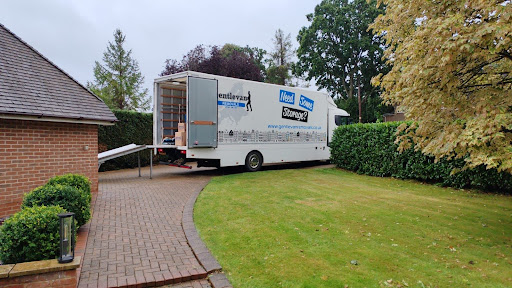
Gentlevan Removals runs regular European removals services between the UK and the continent, with established routes to Spain, France, Italy, Germany, the Benelux countries and beyond. We are Move Assured and AIM accredited, and we offer two months free UK storage on international moves — useful if you're landing in temporary housing or your new home isn't quite ready. You can get an online quote based on volume, route and the services you need.
Get in touch and we'll help you plan the physical side of the move while you handle the paperwork. Good luck with the new job.